Trace every connection back to your core.
The biggest risk is the one you haven't mapped yet.
Forgotten subdomains, third-party scripts, undocumented APIs.
If we scanned your environment today, what would we uncover?
The biggest risk is the one you haven't mapped yet.
Forgotten subdomains, third-party scripts, undocumented APIs.
If we scanned your environment today, what would we uncover?
the problem
Risk lives in the connections no one documented: the digital threads running from a compromised supplier directly into your infrastructure. Every existing tool starts from what you already know. None of them find what you don't.
how it works
Start with agentless discovery across your footprint: domains, IPs, APIs, shadow infrastructure, and every supplier connection attached to them. Layer in Digital Proximity (Patent Pending) to measure how close each risk sits to your core systems. Add AI-driven business, financial, and geopolitical context signals. The result is a ranked picture of real risk, not a list of vendor ratings.
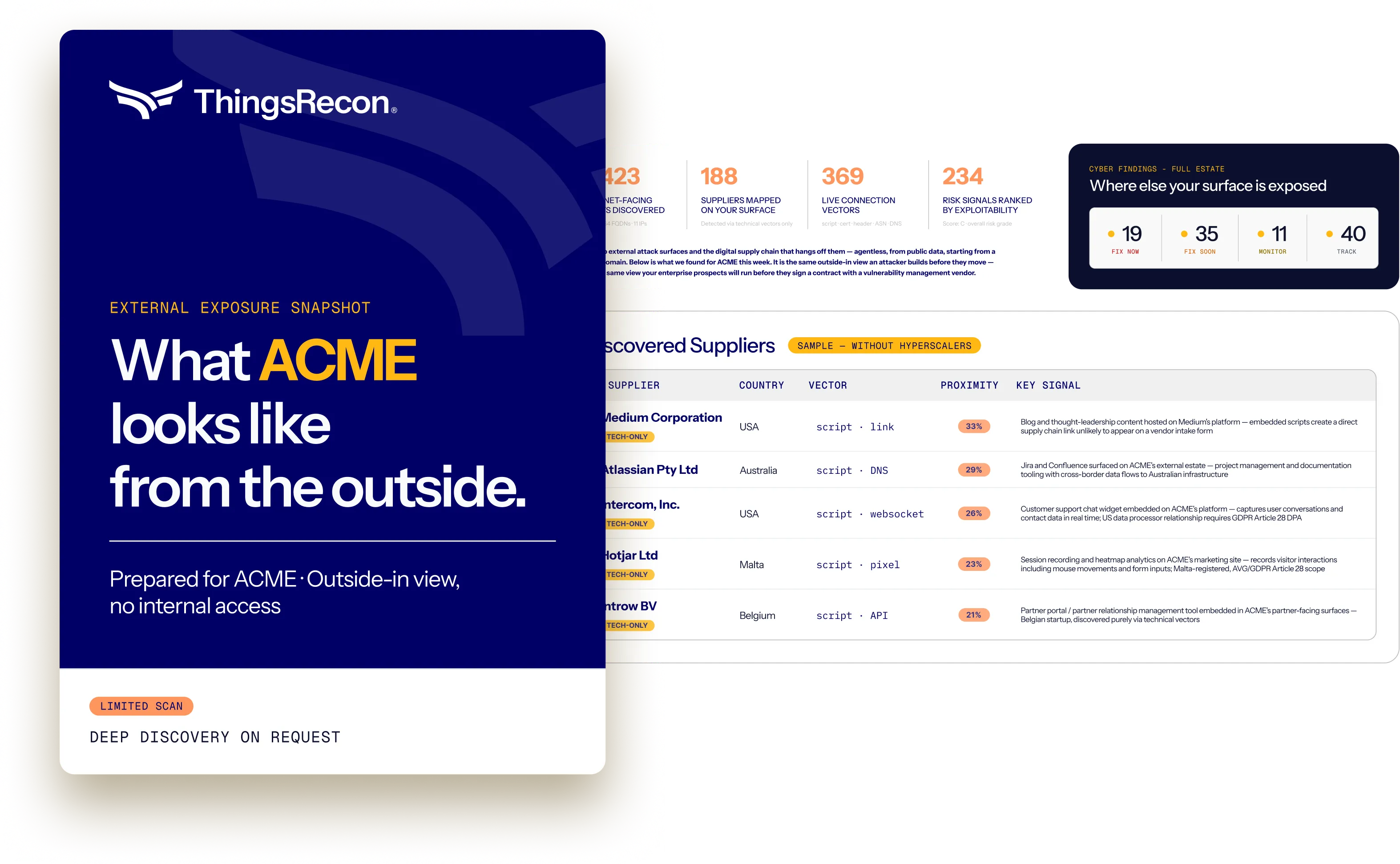
ThingsRecon scans from the outside in. It finds domains, IPs, APIs, shadow applications, and supplier connections, consistently uncovering 3x more active connections than appear on any official vendor list.
Every discovered connection gets a proximity measurement. Suppliers embedded deep in your infrastructure score higher, so instead of a flat vendor list, you get a topology that reflects how an attacker would actually move.
150+ signals per supplier node across technical, business, financial, and geopolitical. AI correlates live exposure with that context continuously, so when a supplier is breached, you know within minutes how it touches you.
attack surface discovery
No manual input, no vendor register upload. Every connection we surface gets a risk score, a proximity rating, and a full inventory.
supply chain intelligence
Every other tool asks: how secure is this vendor? We ask: how deep do they reach? A vendor with a B score sitting close to your core systems is more dangerous than an F-scored vendor with no digital path to anything critical. Digital Proximity is the measure that matters when an incident happens.
Intelligence layer
The Digital Proximity score you see is the output. What builds it is a continuous enrichment layer, scanning technical findings, business intelligence, and external threat signals in parallel, so the picture updates as your supply chain does.
Classic detections cover the technical surface: DNS misconfigurations, expired certificates, weak TLS, software risk. AI-assisted findings go further into ownership changes, geopolitical exposure, sanctions signals, financial distress. Contextual intelligence that doesn't show up in a traditional scan.
Every finding comes with evidence of what was detected, how it's connected, and what to do about it. Not a dashboard to interpret. An answer you can act on.
Conversational Intelligence
Most platforms show you a dashboard and leave you to interpret it. ThingsRecon lets you talk to your supply chain data directly. Ask questions in plain language and get answers drawn from your live supplier map, into a simple chat.
Questions your data can actually answer
Ask questions like “Which of my suppliers have open vulnerabilities right now?” or “How exposed am I to this news event?” and get answers grounded in your live supply chain data — not a generic AI response.
Proactive monitoring and remediation
ThingsRecon doesn’t wait for you to ask. When a relevant incident breaks, it surfaces affected suppliers automatically and tells you the blast radius before you’ve even opened the platform.
Interprets, prioritizes, recommends
Not just data retrieval — the AI layer interprets findings, ranks them by actual risk impact, and recommends the next best action. So your team acts on what matters, not everything at once.
Give us your domain and we'll map the suppliers, dependencies, APIs, scripts, and external connections linked to your organization. Most teams discover something they didn't know was there.

Certifications, breach history, attack surface, data residency, assessed in minutes. Full exposure picture before the contract is signed.
Continuous drift detection: new subdomains, expired TLS, vulnerable components, shadow IT. Alerts fire when risk posture changes.
Find the vendors you don't know about: APIs, SaaS, agencies interacting with your systems. Typically 3x more than documented.
Outside-in target hygiene snapshot: legacy tech, exposed data, vendor inheritance, financial red flags, adverse news, before you sign.
Identify impacted systems and exposed entry points. Locate forgotten assets, stale DNS, exposed admin panels. Contain fast with evidence.
NIS2, DORA, AI Act, continuous evidence of supply chain security posture. Defensible, audit-ready reporting for boards and regulators.
integrations
Plug discovery intelligence directly into the tools your team already uses via API, webhook, or native integration.


thingsrecon scale
+
Internet-facing applications mapped
Organizations onboarded
to full visibility
+
Intelligence signals
per supplier node
GLOBAL INTELLIGENCE
Critical infrastructure operates at national scale. Its exposure has to be measured the same way. ThingsRecon works with governments and national agencies to map supplier risk across entire sectors — energy, finance, healthcare, telecoms — giving security teams and regulators a shared picture of what's connected, and what's exposed.