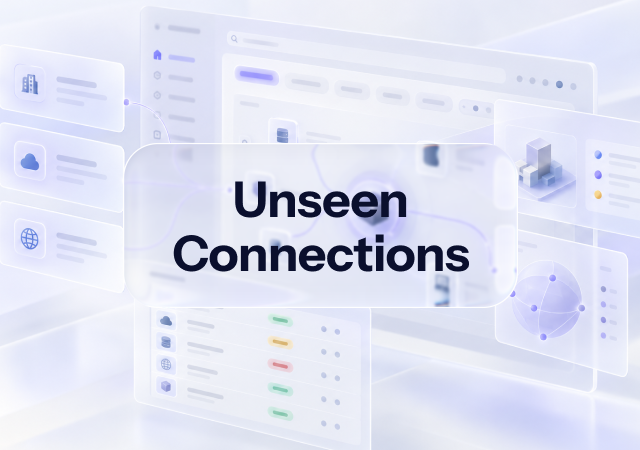


Digital supply chain mapping is the process of identifying and continuously mapping external suppliers and the infrastructure or technical relationships connecting them to an organisation's digital services, so teams can see dependency, concentration and potential blast radius beyond the formal vendor list.
A vendor inventory can tell you which companies the business has recorded. A digital supply chain map shows how external providers actually connect to services, systems and other suppliers. That relationship layer is what turns a list into something useful for cyber risk and resilience decisions.
The output is a relationship map rather than a flat inventory. It shows which external organisations and services are connected, what they appear to support, and where the same dependency appears across multiple parts of the environment.
This sits inside the broader discipline of supply chain intelligence, which combines continuous discovery with relationship context to understand the digital ecosystem around an organisation.
Digital supply chain mapping vs traditional supply chain mapping
A traditional map may follow a product from raw material through manufacturing and distribution to the customer. Its focus is operational continuity across sourcing and logistics.
A digital map follows a different kind of dependency. It may show a customer-facing service relying on an identity provider or cloud platform, including indirect suppliers introduced by those companies.
The two disciplines can overlap around supplier governance, yet they answer different operational questions. Cyber teams use a digital supply chain map to understand dependency structure and potential impact when an external service changes, fails or is compromised.
What does a complete digital supply chain map contain?
In practice, the map should make four layers visible:
- Suppliers: known vendors, previously unknown providers and observable fourth parties.
- Infrastructure and services: the external assets or technologies through which those relationships appear.
- Connections: which supplier or service is linked to which part of the organisation, including indirect dependency chains.
- Relationship depth: context about how close a supplier sits to critical systems and how much impact a failure could create.
That last layer is where Digital Proximity becomes useful. It adds relationship-specific context so a deeply connected supplier can be prioritised differently from one with a peripheral role.
How is a digital supply chain map built?
The detailed discovery method deserves its own treatment because each signal has different strengths and attribution limits. At a high level, teams combine procurement and business records with externally observable evidence, then validate which company or service each relationship belongs to.
The important point is that the vendor list is an input rather than the boundary of the exercise. Discovery can surface additional suppliers, infrastructure, and indirect relationships that were never recorded through procurement.
The broader Supply Chain Intelligence guide explains how continuous discovery connects with relationship context.
What can a digital supply chain map do that a vendor list cannot?
That difference becomes important when something goes wrong. If a provider is breached or unavailable, a flat list may confirm that you use the company. A living map can help determine which systems or suppliers depend on it and whether the same underlying provider appears elsewhere in the environment.
Several practical use cases become much easier once the relationships are visible:
- Blast radius: identify which services and downstream dependencies could be affected by one supplier incident.
- Concentration risk: spot several suppliers relying on the same cloud, identity, hosting or infrastructure provider.
- Incident scoping: move from a vendor name to the specific connections that may place your organisation in the impact path.
- Supplier prioritisation: focus assurance and monitoring on dependencies whose position in the map creates the greatest potential impact.
This is especially important beyond direct vendors. Our guide to fourth-party risk explains why indirect dependencies often remain outside the contractual inventory until an incident forces them into view.
How does a digital supply chain map stay current?
Digital ecosystems change continuously. Teams adopt new SaaS tools, suppliers change infrastructure, services migrate, and relationships are added or removed without waiting for the next annual assessment cycle.
A map therefore needs a refresh model. Continuous discovery and monitoring can detect relationship changes, while validation and business context keep the map useful for decisions.
This also changes how security teams think about offboarding. A supplier leaving the procurement register does not prove that every technical connection has disappeared. A current map can show whether observable remnants remain.
What can a digital supply chain map not tell you?
External mapping has real limits. Some relationships leave no observable technical trace. A visible connection can show that two systems interact without proving the commercial terms behind that interaction. Business criticality may also require confirmation from internal owners.
The further the analysis moves into fourth and nth parties, the more incomplete the evidence can become. A defensible map therefore preserves confidence and evidence rather than presenting every inferred relationship as certain.
The same principle applies to supplier posture. As discussed in our piece on the limitations of security ratings, external evidence is valuable when its scope and context are clear.
Vendor list vs procurement record vs digital supply chain map
A map is useful when it can answer impact questions
The practical test for digital supply chain mapping is simple: when a supplier or shared provider changes, can your team see where that relationship reaches?
A useful map connects suppliers to the services and dependencies around them, keeps those relationships current, and preserves enough evidence to support a decision. That gives security and resilience teams a better basis for incident scoping, concentration analysis, blast-radius assessment and supplier prioritisation than a static list alone.
ThingsRecon builds a living external view of these relationships through Supply Chain Intelligence, then uses Digital Proximity to show which connections sit closest to critical systems.