
the problem
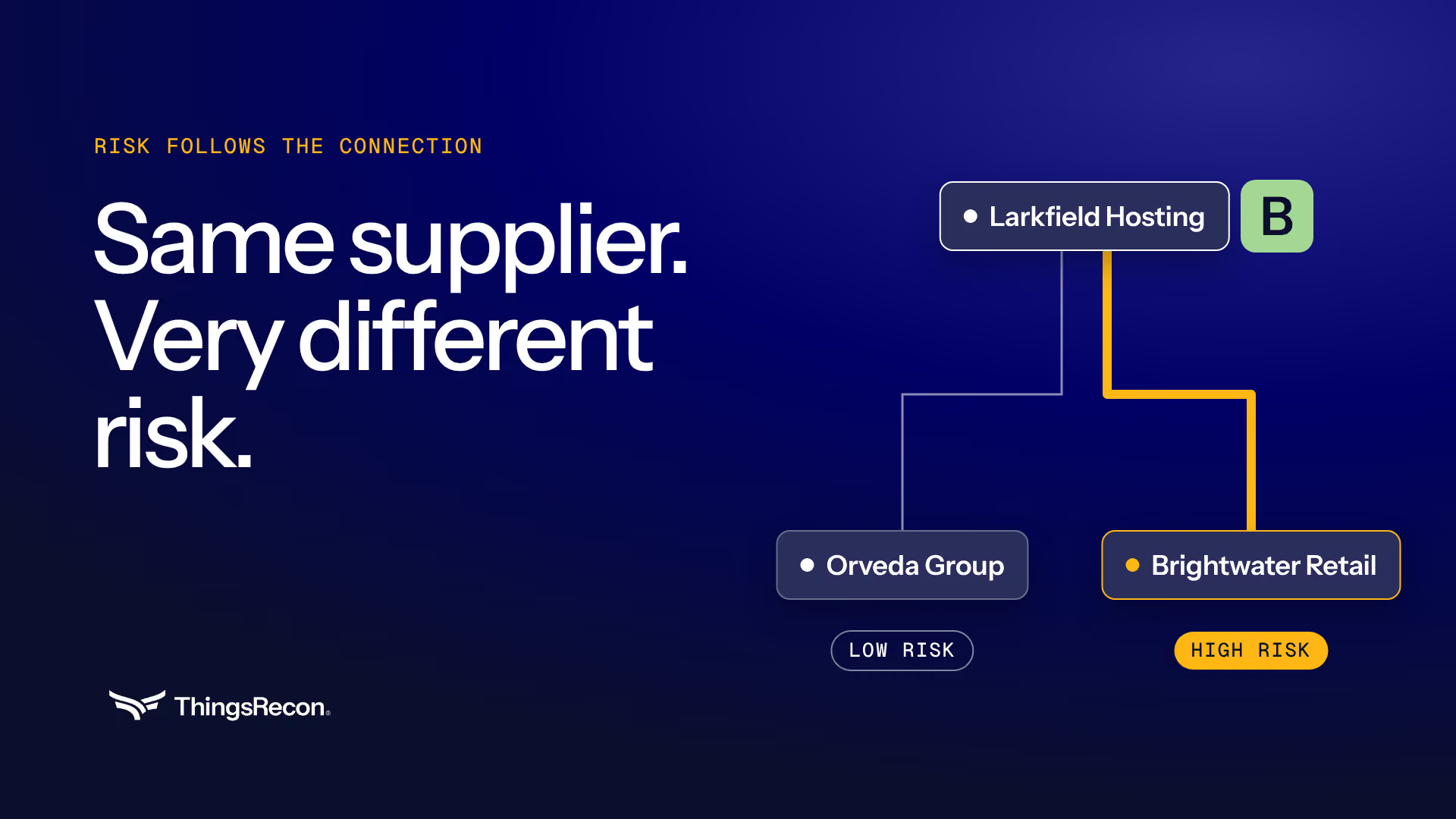
A security rating can't tell you what a breach costs.
Traditional scoring platforms grade a supplier's own external posture.
Supply chain intelligence
ThingsRecon keeps a living map of your digital supply chain, from direct suppliers to the providers behind them, and scores each connection by how much of your business depends on it.
Traditional scoring platforms grade a supplier's own external posture.
Every customer sees the same grade, whether the supplier hosts a forgotten microsite for you, or sits inside the platform that serves your biggest client. That connection is what decides the risk.
TPRM platforms stop at the first layer. ThingsRecon maps the other three from the outside, without asking your suppliers to fill any questionnaires. We call the result Digital Proximity: a proprietary measurement of how close a supplier sits to your critical systems.

The supplier's own posture, including cyber hygiene, financial status, geopolitical ties and compliance.

Embedded services, APIs, hosting, DNS and registrar footprints, and the business unit that uses it.

The services, clients and share of your estate that rely on that relationship.

The contracts, service levels, and regulatory duties riding on those services.


Trusted by global enterprises
of
evaluators chose ThingsRecon after a three-month pilot
days
to onboard a vendor, down from 6 weeks to 3 months
min
to answer "are we impacted?", down from about 2 weeks
%
of the vendor workflow is now automated

The biggest differentiator for me was the proximity.
How am I connected to this vendor? And how deep can I go to understand that connection?
Global Head of Product Security
|
ENTERPRISE CUSTOMER
ThingsRecon shows which contracts depend on each supplier. Multiply a contract's value by the chance an open exposure loses it: that's the loss you avoid each year by fixing it.
Run it on your data
When we scan an organization, we typically find two to five times more connected suppliers than its vendor list holds.
A score for the relationship between your organization and a supplier. It starts from the supplier's own posture, then weights each finding by how the supplier connects to you: which of your services run on it and what data it touches. ThingsRecon calls this Digital Proximity (patent pending).
A vendor rating grades the supplier on its own, so every customer sees the same grade. The connected score uses the same evidence and adds your connection to it, so two customers of one supplier can get very different results. You can switch between both in the platform.
Your domains and, if you have one, your vendor list. We map the connections from the outside, with nothing to install and nothing for your suppliers to fill in.
Private routes such as a site-to-site VPN don't show up from the internet. Those links usually carry less exposure than public ones, and they tend to be documented already because someone had to configure them.