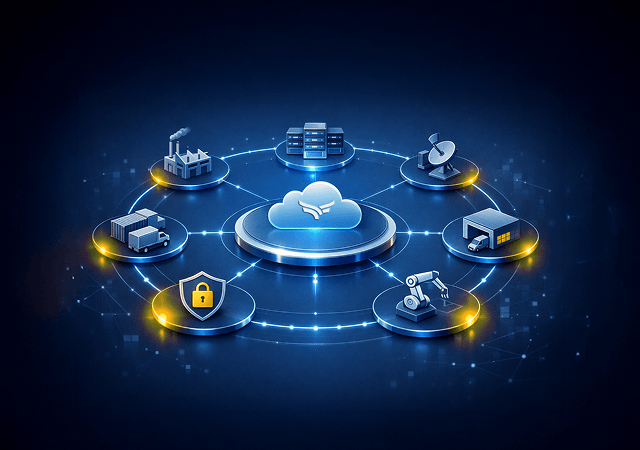

Many supply chain risk programs remain blind because they rely on generic scores, incomplete vendor lists, static evidence, disconnected workflows and findings that lack business context or prioritization.
Supply chain risk is not a new problem. Third-party security incidents have been making headlines for the better part of a decade, and the industry has responded with an expanding toolkit: questionnaire platforms, security ratings services, vendor risk management modules inside GRC suites, and an entire category of compliance frameworks designed to codify what good looks like.
So why do organizations keep getting breached through their supply chain? Why do the post-mortems keep revealing the same failure modes: a trusted supplier with a clean score, a misconfigured integration nobody knew existed, a certificate from a vendor who had been patching inconsistently for months?
The answer, in our experience, is that the tools and processes most organizations rely on are measuring the wrong things. They produce confidence in place of clarity. They generate compliance artefacts instead of risk intelligence. And they leave significant, exploitable blind spots that attackers are increasingly skilled at finding.
What follows is a detailed account of six recurring pain points we have observed across dozens of enterprise security teams. These are the specific gaps between what organizations believe their supply chain risk programs know, and what those programs actually see.
#1 Generic Scores Don’t Reflect Your Actual Business Risk
Security rating platforms have become a standard part of the TPRM toolkit, and for understandable reasons. They are scalable, they require no access to the supplier’s environment, and they produce a number; a simple signal that allows risk teams to triage hundreds of vendors at once. The problem is that what they measure does not answer the question that actually matters.
When a ratings platform generates a score for a given supplier, that score is applied uniformly to every customer of that supplier. It reflects the observable security posture of the vendor’s internet-facing infrastructure: DNS hygiene, certificate management, open ports, email security headers, and similar signals.
It does not reflect how that vendor is connected to your specific environment, which of their systems are active in your production stack, or what the blast radius would be if their infrastructure were compromised.
Consider two organizations using the same cloud-based HR platform. Organization A has a single SSO integration for employee login. Organization B has a deep API integration that syncs employee data in real time, a custom JavaScript widget embedded in their intranet, and a shared data warehouse connection for compliance reporting. Both receive the same vendor score. The risk exposure is categorically different.
In practice, what this means is that the most commonly cited signals of vendor risk — the B+ from a ratings platform, the SOC 2 certificate, the ISO 27001 renewal — can coexist with significant, undetected exposure in the specific parts of a vendor’s infrastructure that are live and active inside your environment.
In one engagement with a media organization, a ratings platform had intentionally minimized the vendor’s domain count to reduce noise in their reports. The result was that nearly 600 domains (and all the applications, certificates, and potential vulnerabilities associated with them) were invisible to the risk program. The score looked clean because the scope was artificially narrow.
What security teams actually need is not a score for the vendor as a company. They need a measurement of that vendor’s risk in the context of how their organization specifically uses that vendor: which systems connect, what data flows, how deep the dependency runs. That measurement requires mapping the actual digital relationship, not scoring the vendor in the abstract.
#2 The Digital Supply Chain Is Invisible Until Something Goes Wrong
The contracted vendor list and the actual digital supply chain are not the same thing. In every organization we have assessed, the number of entities digitally connected to the production environment significantly exceeds what procurement records contain. The gap is not the result of negligence. It is the predictable outcome of how software gets built and deployed.
A developer integrates a third-party analytics library to solve a measurement problem. An IT team provisions a SaaS tool outside the formal procurement cycle because the process is too slow. A project completes, the supplier moves on, but the DNS records, API credentials, and live integrations are never decommissioned. A supplier upgrades their infrastructure and introduces a new fourth-party cloud provider that now routes through your environment. None of these events are logged in the vendor register. All of them create real, exploitable risk.
This pattern of a shadow supply chain, discoverable only through live technical analysis, repeats across verticals:
- A national highway authority had ~150 contracted suppliers on record. A ThingsRecon discovery surfaced 150 digitally connected entities and 351 live applications from a single domain pass.
- A major UK transport authority was aware of approximately 7,000 active vendors, but only ~1,000 had been formally tiered. No existing tool provided a view of which suppliers were digitally embedded at depth versus which existed only in procurement records.
- A government agency scan found script content referencing external services in China. The security team had no record of any supplier relationship that would explain the connection.
- A healthcare provider’s external surface included WordPress plugin installations that were undetected by their existing tooling, only visible through deep application-layer crawling of the kind traditional EASM does not perform.
The digital supply chain is not a static object to be catalogued once. It changes every time a developer makes an integration decision, every time a supplier updates their infrastructure, every time a project begins or ends without complete decommissioning. Any program that relies on point-in-time discovery is already operating on outdated information.
The consequence of this invisibility is not just theoretical. Attackers map the digital supply chain before they move. They find the forgotten subdomain, the exposed API, the third-party script running on an authenticated page. They have time, tools, and methodology. Most risk teams do not have the tooling to run the same playbook continuously and at scale.
#3 Questionnaires and Certifications Are Not Evidence
This is perhaps the most uncomfortable truth in supply chain security, because the questionnaire-and-certification model is so deeply embedded in how the industry operates.
It satisfies auditors. It produces documentation. It gives procurement teams something to point to. It is also structurally incapable of answering the question that matters: what is the actual technical state of the supplier’s environment today, in the specific parts that connect to my systems?
The problem with questionnaires is not that suppliers are dishonest. The problem is that self-assessment is filtered through the supplier’s own understanding of their environment, their interpretation of each question, their bandwidth for completing the form, and their willingness to disclose issues they may be managing internally.
Even with perfect intentions, the output is a representation of how the supplier perceives their security posture, not an objective measurement of it.
The problem with certifications is more structural. An ISO 27001 or SOC 2 Type II audit assesses what controls are in place at the point of the audit, against a defined scope. That scope typically does not include every integration the vendor maintains with every customer. It does not assess whether the subdomain serving JavaScript to your specific application is covered by the same patching schedule as the systems in the audit scope. It is a snapshot of a controlled subset.
Instead of asking the supplier to describe their controls, you observe their environment. You scan the specific applications, APIs, and infrastructure components that connect to your systems. You check the version numbers of components they are serving. You verify whether their stated certificate management practices match what their live certificates show. You identify which parts of their stated compliance scope actually cover the connection points you rely on.
#4 Security Teams Can’t Translate Risk Into Business Language
Even when a security team has good visibility into their supply chain risk posture, they face a second, equally difficult problem: communicating what they know in a way that boards, CFOs, and procurement leaders will act on. The language of cyber risk — CVE scores, hygiene grades, misconfiguration types — does not translate naturally into the language of business decisions, budget approvals, or executive risk committees.
This is not a communications failure on the part of security teams. It is a structural gap in how most risk tools present their findings. A dashboard of vendor scores and open finding counts does not answer the question a CFO asks: what is this costing us in expected loss, and what would it cost to fix it? Without that translation layer, even the most technically rigorous supply chain risk program struggles to secure the resources and executive engagement it needs.
“If I can’t tell the CFO this specific risk is worth $2.3 million in expected loss, I won’t get budget to fix it. And if I get budget based on a fear pitch, I lose credibility the next time. The translation from technical finding to financial consequence has to be in the tool — it can’t live only in my head.”
— Risk Lead, Financial Services Organization
The request that came up repeatedly across enterprise conversations was not for more technical detail; most security teams have sufficient technical depth. What they needed was a layer that converts technical findings into business consequences: breach probability weighted by connection depth, expected financial impact drawing on public breach cost data, regulatory exposure tied to specific findings, and remediation priority expressed in terms of business impact rather than CVSS scores.
This creates a practical requirement: supply chain risk tooling must not only surface findings but also integrate with the workflows where risk decisions are documented. A finding that lives in a security dashboard but never reaches a risk register is not a finding that has been managed — it is a finding that has been observed and left unaddressed. In the event of an incident, that distinction matters enormously.
#5 Current Tools Don’t Connect to How Work Actually Gets Done
A supply chain risk finding that exists only in a security dashboard has limited value. For risk intelligence to drive actual security improvement, it needs to flow into the systems where decisions are made, actions are assigned, and outcomes are tracked.
In most enterprise organizations, that means GRC platforms, ticketing systems, and risk registers. Yet the integration between supply chain risk tooling and those systems is often absent, fragile, or one-directional.
The workflow friction this creates is significant. Security teams discover a finding in their supply chain risk tool, manually extract the relevant information, create a ticket in their GRC or ticketing system, assign it to a remediation owner, track the outcome separately, and then update the risk register to reflect the treatment decision.
Each of those steps is manual. Each creates an opportunity for findings to be delayed, miscommunicated, or lost. And in organizations managing hundreds or thousands of supplier relationships, the manual burden compounds rapidly.
There is also a liability dimension to workflow integration that is easy to overlook. As noted earlier, regulatory frameworks are moving toward expectations of documented risk treatment decisions. A finding that has been discovered but not documented in a risk register (because the integration required to get it there didn’t exist) is a finding that has been negligently managed from a governance perspective.
The practical implication for procurement decisions around supply chain risk tooling is that integration capability should be weighted as heavily as detection capability. A tool that discovers more but integrates with nothing produces intelligence that sits unused. A tool that discovers the right things and delivers them directly to the systems where decisions are made drives outcomes.
#6 Resource Constraints Make It Impossible to Operationalize Findings
Even for organizations that have invested in supply chain risk tooling with good discovery coverage, there is a final, practical problem: the volume of findings often exceeds the team’s capacity to act on them.
Supply chain risk is one of many priorities competing for the time of security teams that are already stretched. When a scan surfaces hundreds of findings across dozens of suppliers, the question of where to start, and how to keep pace with new findings as they emerge, is not a trivial operational problem.
This challenge is amplified by a structural issue in how most risk tools present findings. Without contextual prioritization — specifically, without a measure of how critical each finding is given the nature of the connection between the organization and the supplier — every finding looks roughly equal.
Teams end up triaging by gut feel or defaulting to the highest CVSS scores, neither of which accurately reflects business risk. The result is that genuinely critical exposure, such as a deeply embedded supplier with a misconfigured API, may wait in a queue behind a lower-priority finding from a supplier with a high rating who has a minor header misconfiguration.
“The issue isn’t awareness. We know we have supply chain exposure. The issue is that we don’t have the headcount to turn awareness into action. We need a tool that tells us exactly where to start and makes the first three steps obvious — not a platform that shows us the size of the problem and leaves us to figure out the rest.”
— Security Operations Lead, Global Manufacturing Organization
The resource constraint problem has a structural solution that the industry is beginning to move toward: managed delivery. Rather than expecting every security team to operationalise supply chain risk intelligence independently, the model that works in practice involves a partner layer: GRC consultants, MSSPs, and security advisory firms who sit between the technology and the client team, translating discovery output into remediation programs, managing continuous monitoring, and delivering the findings in a form the internal team can act on within their existing capacity.
There is a prioritisation technology dimension to this as well. Contextual risk scoring — ranking findings by the combination of technical severity and connection depth — is the mechanism that makes supply chain risk intelligence actionable within constrained resources. When a team is told that these five findings, across these three suppliers, represent 80% of their meaningful exposure, they can work with that. When they are given 300 findings of roughly equal apparent priority, they cannot.
The shift required is from comprehensive to consequential. Supply chain risk tools should not aim to surface every possible finding at equal weight. They should aim to surface the findings that matter most given the actual digital relationship between the organization and the supplier, and present them in a sequence that reflects genuine business risk. That is the difference between a tool that demonstrates the scale of the problem and a tool that helps solve it.