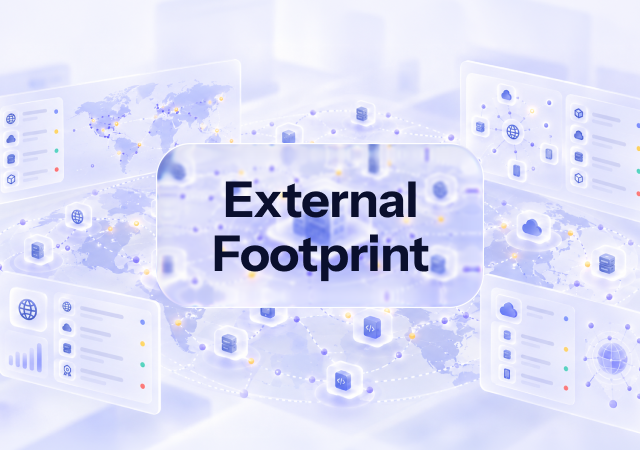

Shadow IT discovery combines outside-in reconnaissance with asset context to uncover unknown domains, cloud services, SaaS use and exposed systems missing from official inventories.
Security teams discover shadow IT by running continuous, passive external scans that map every domain, subdomain, script and vendor connection tied to the organization, then comparing that list against the official asset inventory. Anything present in the scan but missing from the inventory is shadow IT. This outside-in approach finds unmanaged assets that employee surveys and agent-based tools miss entirely.
Most organizations still find shadow IT by accident: a procurement invoice for a tool nobody remembers approving, or an audit finding nobody can explain. That reactive pattern is why the same conversation keeps happening on customer calls and incident reviews. There's a more direct way to run this, and it doesn't start with asking employees what they've signed up for.
What are the steps to surface shadow IT?
Surfacing shadow IT takes five practical steps: enumerate every domain and subdomain tied to the organization, inspect the scripts and dependencies those assets load, map vendor and supplier connections rather than just internal servers, run scans passively and continuously instead of once a year, and reconcile every result against the official asset inventory to flag what's missing.
- Enumerate every domain and subdomain connected to the organization, including the ones nobody registered on purpose. Full DNS enumeration, subdomain brute-forcing, certificate transparency checks and reverse WHOIS lookups routinely turn up assets that predate the current security team or were spun up by a business unit that never looped in IT.
- Inspect the scripts and software dependencies each discovered asset actually loads, not just the domain itself. A single marketing microsite can pull in a dozen third-party scripts, and any one of them is a route into the organization if it's compromised. In one recent scan, this level of inspection surfaced more than 1,600 distinct script variants across a single organization's external footprint.
- Map vendor and supplier connections, not just internally owned infrastructure. Shadow IT increasingly enters through procurement gaps rather than employee laptops: a business unit signs up for a SaaS tool, or a vendor stands up infrastructure on the organization's behalf, and neither ends up in the CMDB. Supplier mapping run alongside asset discovery has identified relationships to close to 300 companies that were never in a formal vendor inventory.
- Scan passively and continuously, not once a year. Active scanning and credentialed agents only see what they're pointed at and what already has an agent installed. Passive, evidence-based discovery run on a recurring cadence, weekly or monthly rather than annually, catches what changes in between and skips the disruption of active probing.
- Reconcile every discovered asset against the official inventory and flag the gap. Discovery only becomes useful once it's compared against what the organization believes it owns. A proof of concept run this way turned up more than 84,000 distinct assets across a set of customer domains, none of which had appeared in any existing inventory.
These aren't abstract numbers. They're the reason CISOs keep finding assets they can't explain, usually after a business unit has already been running a tool for months. The scale of what turns up is also why shadow IT keeps growing rather than shrinking: new tools get added faster than anyone can log them.
Why do security tools miss shadow IT?
Endpoint agents and vulnerability scanners only see what they're installed on or pointed at, so anything outside that known scope stays invisible by design. Attackers don't share that limitation. They run the same reconnaissance techniques, DNS lookups and certificate checks among them, against the entire internet-facing footprint, which is why an outside-in view built on the same recon tactics attackers use finds things that inside-out tools structurally cannot.
If your discovery method needs an agent installed or a business unit to self-report, it was never going to catch the tool that unit didn't tell anyone about.
What’s the impact of third-party vendors on shadow IT?
Shadow IT introduced by a third party is harder to find and more consequential when it surfaces, because the exposure sits on infrastructure the organization doesn't control and often doesn't know exists.
A vendor's marketing agency spins up a microsite on the vendor's domain, or a supplier reuses shared infrastructure across several clients, and the resulting exposure inherits straight into the organization's own attack surface without ever touching an internal system.
That relationship is what turns individual shadow IT into shadow supply chain risk: the same discovery techniques that find an org's own unknown domains also find the vendor and fourth-party connections that most vendor risk programs never get to because those programs run on questionnaires rather than external evidence.
Point-in-time checks versus continuous discovery
A shadow IT inventory built once a year during an audit is out of date within weeks. New domains get registered and new SaaS tools get purchased on a company card long before the next assessment cycle comes around, and none of it waits for anyone's permission.
Teams that have shifted from static, point-in-time vendor assessments to continuous, evidence-based monitoring describe the change less as a technology upgrade and more as finally seeing the organization the way it actually behaves day to day, instead of the way it looked on the day someone last checked.
Discovery on its own is only half the job. What matters is turning what a scan finds into something a security team can actually act on, which is where AI-assisted triage of scan results, reading scripts and configurations for context rather than just flagging their existence, is starting to cut the manual work of sorting real risk from noise.
None of this requires guessing at what employees might be doing. It requires looking at the organization from the outside, the way anyone else on the internet already can, and being honest about the gap between that view and the official inventory.
If you want to see what a scope-limited scan of your own domains would turn up, ask for one. It usually takes less time to run than it takes to explain to a board why nobody knew about the assets it finds.
The fastest way to find shadow IT
Discovering shadow IT means running continuous, passive external scans that cover DNS records, subdomains, scripts and vendor connections, then comparing every result against the official asset inventory. Anything the scan finds that isn't in that inventory is shadow IT.
This works better than employee surveys or agent-based tools because it doesn't depend on someone remembering to report a new domain or SaaS tool. The same approach extends to vendors, since mapping supplier and fourth-party connections finds shadow IT that originates outside the business as well as inside it.