Digital Supply Chain Attack Statistics 2026
A sourced overview of the latest statistics on supply chain attacks, third-party breaches and the growing cost of digital dependency risk.

Every major breach report published in 2025 and 2026 points to the same structural problem: organizations are making security decisions based on an incomplete picture of what is connected to their infrastructure. The number keeps changing. The root cause does not.
This piece compiles the most relevant supply chain attack statistics for 2026 — drawing from the Verizon DBIR, IBM's Cost of a Data Breach research, Cybersecurity Ventures projections, and ThingsRecon's own discovery data — and frames what they mean for security teams managing third-party risk today.
The headline numbers for 2026
The data from the most authoritative sources in cybersecurity tells a consistent story. Supply chain risk is no longer a niche concern for large enterprises. It is the dominant breach vector, and it is accelerating.
The Verizon figure is particularly striking because it represents a 100% year-over-year increase. In one reporting cycle, the share of breaches involving third parties went from 15% to 30%. That is not incremental drift. It reflects a structural shift in how attackers approach enterprise targets.
What a supply chain attack actually means
The term gets used interchangeably with "third-party breach" in most reporting. They are not the same thing, and the distinction shapes how you defend against each.
A third-party breach is an event: your vendor was compromised. Your concern is their security posture, your contractual obligations, what data may have been exposed.
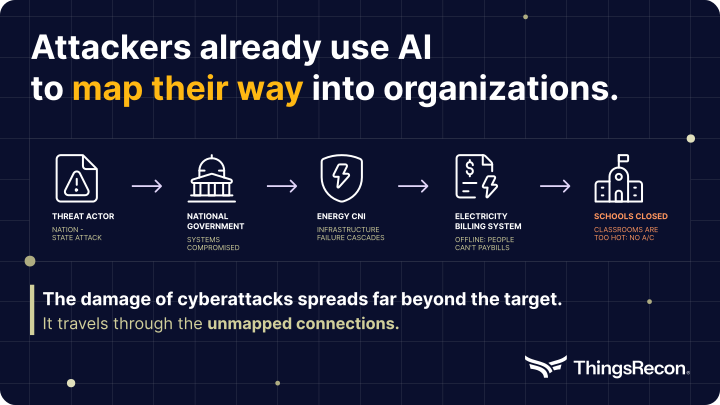
A supply chain attack is a method: the attacker uses that compromised vendor relationship as a launchpad to reach you. The trust your organization places in a vendor's update, certificate, or API call becomes the attack vector. You inherit the breach without being directly targeted. One vendor. Mass impact.
The 3CX incident in 2023 illustrates this clearly. Attackers first compromised Trading Technologies' software. An employee at 3CX installed that compromised software. Attackers pivoted to 3CX's build infrastructure, injected malicious code into a signed software update, and distributed it to 3CX customers. Three organizations, one cascade. No customer had any indication of risk at their own perimeter.
What makes this particularly hard to manage is that the entry point was not a vulnerability in the traditional sense. It was a trusted relationship — and most organizations have no systematic way to map, monitor, or assess the security posture of the full chain of relationships behind their first-tier vendors. That gap is where external dependencies increase risk.
The financial impact: breach cost by vector
The IBM Cost of a Data Breach 2025 report put the global average at $4.44M per incident — the first decline in five years, driven by faster detection and containment. The improvement is real. It does not change the picture for supply chain-originated breaches, which remain among the most expensive and longest-running incidents to resolve.
In the UK specifically, IBM's research found that supply chain compromise adds an average of £241,620 to the total breach cost compared to other vectors. The identification and containment lifecycle for supply chain breaches averages 267 days — a full week longer than malicious insider attacks.
Organizations using AI-powered security tools reduced their average breach cost by $1.9M compared to those without automation, and identified breaches 80 days faster. The gap between AI-enabled and non-AI-enabled teams is widening annually. (IBM, 2025)
The longer-term cost trajectory is more concerning. Cybersecurity Ventures projects that global annual costs from software supply chain attacks will reach $60 billion in 2025, climbing to $138 billion by 2031. These are not breach response costs alone. They include operational disruption, regulatory penalties, reputational damage, and the cumulative cost of cascading failures through interconnected supply chains.
Which sectors get hit hardest
Healthcare has led breach cost rankings for 15 consecutive years, reaching $7.42M per incident — driven by HIPAA penalties, patient data value, and the operational urgency that forces rapid system restoration at any cost. Financial services follows at $5.56M, with critical infrastructure at $4.82M.
The more significant trend in the 2025 data is the shift in attacker motivation. The Verizon DBIR noted a dramatic rise in espionage-motivated breaches in manufacturing — from 3% to 20% of incidents in the sector in a single year. This is not financially driven opportunism. It reflects nation-state interest in industrial intellectual property and operational disruption potential.
For organizations in regulated European sectors — financial services under DORA, critical infrastructure under NIS2, defense supply chains under CMMC — this is particularly material. The attackers targeting your supply chain are not necessarily after your data. They may be after the supplier's supplier, using your environment as transit.
Regional Lead Consultant, BAE Systems Digital Intelligence · All Things Cyber Podcast, Ep. 5
The visibility gap behind the numbers
The statistics above describe what happens when a supply chain attack succeeds. They do not explain why so many do. The answer is simpler than most organizations want to admit: the map does not match the territory.
Most organizations maintain vendor lists. Very few have an accurate, real-time picture of what those vendors are connected to in their environment. The gap between the declared vendor list and the live digital connection map is where supply chain risk lives.
When ThingsRecon runs a digital supply chain discovery scan — starting from an organization's own domains and working outward through DNS records, scripts, API endpoints, headers, and certificates — the results consistently show a picture larger than anyone expected:
Active third-party connections run two to five times the official vendor count. Suppliers approved for one integration are connected in three. Tools adopted by individual teams without procurement involvement are embedded in production infrastructure. Subdomains from old integrations point to active third-party services.
This is not a sign of organizational failure. It is the natural consequence of how digital supply chains grow — every team, every project, every new vendor relationship adds connections, and the inventory expands faster than any manual process or annual questionnaire can track.
What organizations consistently miss
The NIST framework talks about third-party risk management. DORA requires organizations to identify ICT third-party dependencies. NIS2 mandates supply chain security for essential and important entities. What the frameworks have in common is a shared assumption that the organization already knows who its third parties are.
In practice, that assumption is wrong more often than it is right. When ThingsRecon works with security teams on discovery assessments, the question that surfaces in almost every engagement is a variant of: we didn't know that was still connected.
The categories of unknown connections tend to cluster around a few patterns:
Regulatory pressure: NIS2, DORA, and what they require
The regulatory environment in Europe has shifted significantly in the last 18 months. Both NIS2 and DORA include explicit requirements around supply chain and third-party risk that go well beyond annual vendor assessments.
NIS2 requires essential and important entities to address security in the supply chain, including security-related aspects of the relationships between each entity and its direct suppliers or service providers. The obligation extends to understanding what your suppliers' security posture is — not just what they self-report on a questionnaire.
DORA requires financial entities to maintain a register of all ICT third-party service providers, including subcontractors. It introduces tiering requirements and specific obligations around critical third-party providers — but only for providers the organization can identify. The discovery problem sits upstream of compliance.
The World Economic Forum's Global Cybersecurity Outlook 2025 identified "cyber inequity" as a primary driver of supply chain risk: the security gap between large organizations and their smaller, less resourced suppliers creates the attack surface that adversaries exploit. DORA and NIS2 are beginning to address this structurally, but the compliance requirement to know your supply chain cannot be met without the technical capability to discover it.
Both NIS2 and DORA reference continuous visibility as a requirement, not periodic assessment. A vendor questionnaire completed once a year does not satisfy the intent of either framework — and it does not reflect how supply chains change. New integrations, new subprocessors, and new infrastructure dependencies emerge between audit cycles.
From statistics to action
The statistics in this piece describe a real and growing problem. The question for any security or GRC team is what to do with them.
Prevention alone is not a viable strategy. The 2025 Verizon DBIR analyzed over 22,000 incidents — the largest dataset in DBIR history. The pattern is clear: supply chain exposure is structural, not episodic. Organizations that treat it as an event to respond to rather than a condition to manage continuously will remain in reactive mode.
The most effective shift is moving from a declared-relationship model to a discovered-reality model. That means:
-
Step 1Start from the outside in
Rather than working from a vendor list and asking what risk each vendor carries, start from your own domains and map what is connected. DNS, scripts, API calls, certificates, headers — these leave traces. A full discovery scan reconstructs the real picture.
-
Step 2Continuous monitoring, not periodic audits
Supply chains change faster than audit cycles. A vendor relationship that was clean in Q1 may have added a new subprocessor, changed CDN providers, or introduced a new integration by Q3. The risk profile changes without any action on your part.
-
Step 3Prioritize by actual exposure
Not all third-party connections carry equal risk. Digital Proximity™ scoring weights risk by the nature of the connection, the data flow, the vendor's own external posture, and the supplier's supplier relationships. This makes the picture actionable rather than just large.
The answer to the fundamental question — do you know what is connected to your infrastructure right now? — is the starting point for everything else.
Sources
Verizon Business, 2025 Data Breach Investigations Report (DBIR)
IBM Security / Ponemon Institute, Cost of a Data Breach Report 2025
Cybersecurity Ventures, Software Supply Chain Attacks Forecast 2025–2031
World Economic Forum, Global Cybersecurity Outlook 2025
Sonatype, 2024 State of the Software Supply Chain
ThingsRecon, Internal discovery scan data, 2024–2026
CISA/FBI, Advisory AA22-264A (Albania cyberattack)
What’s
connected
to you right now?
